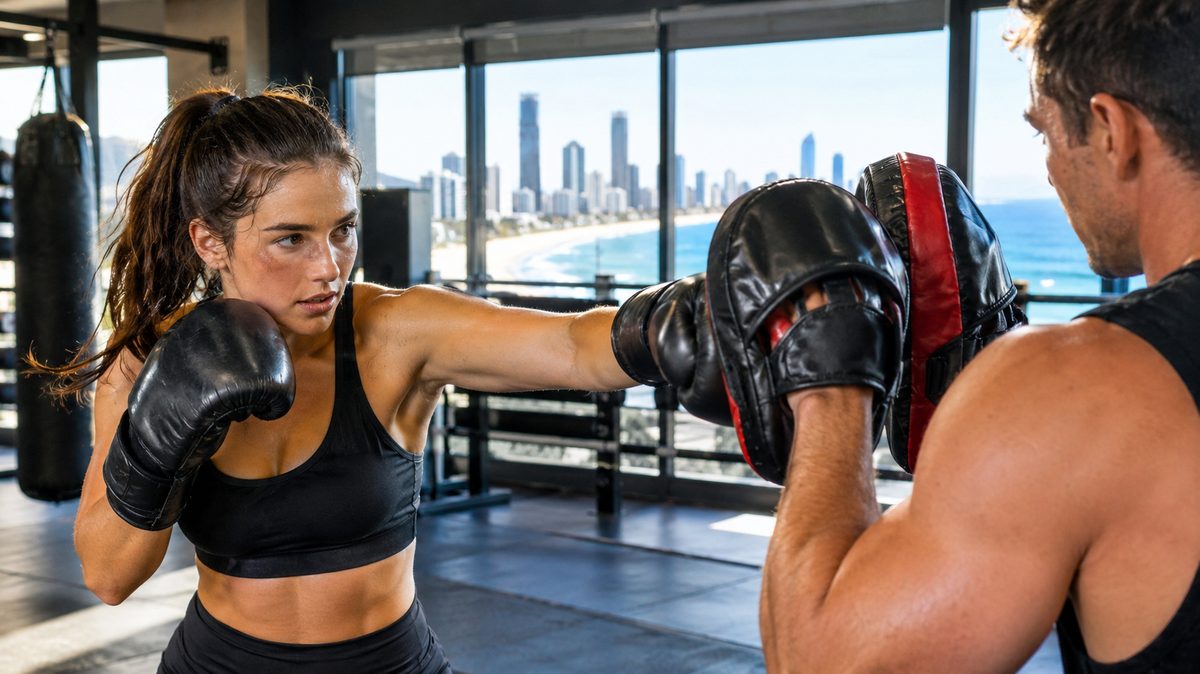
Boxing personal training gives beginners a full-body workout while a coach teaches safe punching, footwork and fitness at a suitable pace. You do not need boxing experience or plans to enter a ring. Fitness boxing uses boxing skills as Exercise, with sessions shaped around your current ability and goals.
A good beginner program builds Physical fitness through simple skills and steady progress. You learn how to stand, move, punch and recover before the work becomes harder. This structure matters because fast punches performed with poor form can strain the wrists, elbows or shoulders.
For people living in Gold Coast, Queensland, personal sessions also offer a practical way to train around heat, humidity and a busy schedule. The coach can adjust the session location, rest periods and intensity instead of forcing you into a fixed group workout.
What does fitness boxing involve?
Fitness boxing combines boxing technique with conditioning. A session may include stance practice, pad work, Punching bag drills, footwork and bodyweight movements. You usually punch pads or a bag rather than another person.
The main idea is controlled effort. Each punch begins at the floor. Your feet hold your position, your hips turn, and your upper body transfers that force through the arm. The hand then returns to guard. This sequence turns boxing into a whole-body movement instead of an arm workout.
Beginners often expect constant hard punching. That is rarely the best starting point. Early sessions should give you enough time to reset your stance and think about each movement. Speed becomes useful after you can control the path of the punch.
A trainer might begin with short rounds of basic straight punches. The next step may add movement between combinations. Later rounds can include hooks, defensive slips or conditioning work. Each layer should have a clear purpose.
Why is personal coaching useful for a beginner?
Personal coaching gives you immediate feedback. A coach can see when your wrist bends, your chin lifts or your feet cross. Fixing those habits early makes training safer and helps each punch feel smoother.
It also lets the workout match your starting level. One beginner may have good general fitness but poor coordination. Another may understand the movements yet tire after one minute. Giving both people the same round length would make little sense.
In a typical beginner case, a client may arrive worried that slow reactions will make boxing embarrassing. A useful coach reduces the number of instructions and starts with one target. Once the client can land a relaxed jab, the coach adds the cross. Confidence grows from small skills that work, not from being pushed into a complex combination.
One-to-one training can also reduce wasted effort. If you struggle to turn your hips, the coach can pause the workout and teach that part on its own. In a busy class, the same fault may go unnoticed for several sessions.
What happens during the first session?
Your first session should begin with a brief talk about your goals, training history and any pain or health concerns. The coach may ask what other activity you do and how long it has been since you exercised. Give clear answers. The plan can only fit you when the starting point is accurate.
The practical work often begins with stance. You learn where to place your feet, how to bend your knees and where to hold your hands. The coach may then teach a jab and cross at low speed. These straight punches are easier to control than wide swinging shots.
Expect a simple warm-up followed by technique rounds. Conditioning may come later in the session once the coach has seen how you move. The workout should finish with a gradual reduction in effort and a quick review of what to practise next.
You should leave feeling that you learned something. Total exhaustion is not proof of a good first session. If fatigue causes your hands to drop and your punches to lose shape, the round has gone on too long.
Which boxing skills should you learn first?
Start with a stable stance and guard. Your stance gives you a base for punching and lets you move without losing balance. Your guard protects your face and creates a reliable position to which each hand can return.
Next, learn the jab and cross. The jab helps you judge distance. The cross teaches you to turn through the hip while keeping your feet connected to the floor. Aim for a clean return to guard after every punch.
Footwork comes before fancy combinations. Practise taking short steps while keeping the same distance between your feet. Avoid bringing the feet together or crossing one behind the other. Good footwork lets you reach the target without leaning.
Breathing is another basic skill. Breathe out briefly with each punch. Do not hold your breath through a full combination. A steady breathing pattern helps you stay relaxed and makes longer rounds easier.
Defence can begin with simple movements such as bringing the gloves back to the cheeks or stepping away from range. Even when there is no sparring, defensive practice improves posture and control.
How does boxing improve fitness?
Boxing can train several parts of Physical fitness within one session. Repeated rounds raise your heart rate, while footwork and punching ask the muscles to keep producing force. The changing pace also teaches you to recover while you remain active.
Longer rounds performed at a steady pace act as Aerobic exercise. Your heart and lungs supply energy while you keep moving. This base makes it easier to complete later rounds without a sharp drop in technique.
Short, hard rounds can work as High-intensity interval training. For example, a trainer may use a brief burst on the bag followed by a longer recovery. The work period must still suit your skill. Fast, uncontrolled punching adds risk without adding much value.
Endurance training also has a local role within the arms, shoulders and legs. Holding your guard becomes hard when the shoulders tire. Staying light on your feet becomes harder as the calves fatigue. Planned rounds build this capacity over time.
Boxing develops Core stability because the trunk must control force while the arms and hips move. A stable trunk helps you rotate without twisting through the lower back. This does not mean keeping the body stiff. Effective movement needs controlled rotation followed by a quick return to position.
What equipment do you need?
Most beginners need comfortable training clothes, supportive shoes, a Boxing glove and a Hand wrap for each hand. Many trainers provide gloves for an introductory session, but owning a suitable pair is more hygienic and gives you a consistent fit.
Gloves should feel secure without crushing the fingers. The wrist section should close firmly. A loose glove may shift during pad or bag work, while a glove that is too small can make it hard to form a natural fist.
Wraps support the small joints of the hand and help manage sweat inside the glove. Ask your coach to show you how to wrap your hands. The wrap should support the wrist and knuckles without cutting off circulation. Tingling or numb fingers mean it is too tight.
You do not need to buy a Punching bag before your first session. Home bag work can reinforce poor habits when no one checks your distance or wrist position. Learn the movement first, then decide whether home equipment would help your plan.
Bring water and a small towel, especially for outdoor or garage-based sessions. Gold Coast heat can raise the effort level even when the workout has not changed.
How hard should a beginner train?
Train hard enough to raise your breathing while keeping control of your stance and punches. If you cannot return your hands to guard or follow a simple instruction, reduce the pace.
A useful effort scale runs from one to ten. Early skill rounds may sit near four or five. Conditioning rounds might rise to seven. Beginners rarely need repeated maximum-effort rounds because fatigue can hide technical faults and delay recovery.
Rest is part of the session design. A new client might start with short rounds and generous breaks. As fitness improves, the coach can extend the rounds or shorten recovery. Changing one demand at a time makes progress easier to judge.
Muscle fatigue and mild soreness can occur after a new workout. Sharp pain, swelling, dizziness or pain that changes your movement is different. Stop and tell the trainer. Seek medical advice when symptoms are severe, unusual or persistent.
How often should you do boxing training?
Two coached sessions each week give many beginners enough practice to remember the skills while allowing time to recover. One weekly session can still work when you add short, low-impact practice between appointments. More sessions are useful only when your body is recovering well.
Progress depends on regular practice rather than one punishing workout. Ten minutes of stance, guard and footwork at home can support what you learned without adding heavy impact. Shadowboxing is useful because it lets you slow down and watch your position.
Keep other training simple at first. Walking or easy cycling can support your aerobic base. Basic strength work can help the legs and trunk handle boxing positions. Avoid adding several hard workouts in the same week before you know how your body responds.
Track practical signs of improvement. You may recover faster between rounds, keep your guard up for longer or move without crossing your feet. Body weight alone will not show these changes.
Do you have to spar or get hit?
No. Fitness boxing does not require sparring. You can gain a demanding workout from pads, shadowboxing and bag drills without another person throwing punches at you.
Sparring is a separate training choice. It involves contact, faster decisions and a higher level of risk. A trainer should never present it as a surprise part of a fitness session or pressure a beginner to take part.
If learning practical boxing defence interests you, tell the coach. They can first teach distance, guard and safe partner drills with clear limits. Contact should only enter the plan after you understand what it involves and freely agree to it.
How can you choose the right Gold Coast trainer?
Choose a trainer who can teach beginners, explain technique in plain language and adjust the workout when form declines. Boxing experience matters, but the ability to coach your current level matters more than a long list of personal fight results.
Ask what a normal beginner session includes. Find out whether the service focuses on fitness boxing, competitive boxing or both. Confirm whether sessions use pads, bags or partner drills. You should know what you are booking.
Watch how the trainer handles safety. They should ask about injuries and explain how equipment fits. They should also control intensity instead of treating every round as a test of toughness.
Location and session time affect consistency. A skilled trainer will not help much if travel across the Gold Coast makes regular attendance unrealistic. Choose a format you can keep using, whether that is a studio, outdoor space or mobile service.
A trial session should leave you with clear feedback. The trainer should be able to name the first skill you need to improve and explain how the next sessions will develop it. Vague promises about getting fit are not a training plan.
What should you do before booking?
Write down your main goal and any limits that may affect training. Then ask the trainer how the first month would be structured for someone at your level.
- Confirm that the coach regularly trains boxing beginners.
- Ask whether gloves and wraps are supplied for the first session.
- Explain any injury, medical condition or long break from Exercise.
- Check the session location, cancellation terms and total cost.
- Choose a weekly time you can attend with little disruption.
Your single next step is to book one beginner assessment and judge the coach by how clearly they teach safe stance, punching and progress.